




T for Temperature
The IPCC Special report was published on October 8, 2018, in response to an invitation from the United Nations Framework Convention on Climate Change (UNFCCC) when it adopted the Paris Agreement in 2015. Signed at the end of the Conference of the Parties, the Agreement included the aim of strengthening the global response to the threat of climate change by “holding the increase in the global average temperature to well below 2°C above pre-industrial levels and pursuing efforts to limit the temperature increase to 1.5°C above pre-industrial levels.” As part of the decision to adopt the Paris Agreement, the IPCC was invited to produce, in 2018, a Special Report on global warming of 1.5°C above pre-industrial levels and related global greenhouse gas emission pathways. The IPCC accepted the invitation, adding that the Special Report would look at these issues in the context of strengthening the global response to the threat of climate change, sustainable development, and efforts to eradicate poverty. Thus, the report highlights connections and links among climate change, increasing temperature and the 17 Sustainable Development Goals (SDGs) defined by the United Nations.
Enlarge
http://ipcc.ch/report/sr15/
The increase in global mean surface temperature impacts all these efforts and, according to the authors (91 scientists from 44 countries), a half degree matters in many sectors, including frequency and intensity of extremes, impacts on terrestrial and marine biodiversity, ecosystems and their services, health, livelihoods, food and water supply, human security, infrastructure, and economic growth. In other words, we can state that risks are significantly lower for natural and human systems for global warming of 1.5°C than for 2°C. If we would hit the target, we would secure a number of benefits, IPCC explains. But human activities have already caused global warming of approximately 1°C above pre-industrial levels.
T for target
The future is the core of the issue. Indeed, future warming largely depends on future emissions, the IPCC reports. “The target is non-impossible”, said Hoesung Lee, Chair of the IPCC, by opening the press conference in Incheon, Republic of Korea, “but it will require rapid, far-reaching and unprecedented changes”. These efforts would produce concrete results compared to a world warmer by 2°C. Some examples can clarify the difference: by 2100, global sea level rise would be 10 cm lower with global warming of 1.5°C; the likelihood of the Arctic Ocean free of sea ice in summer would be once per century with global warming of 1.5°C, compared with at least once per decade with 2°C; coral reefs would decline by 70-90 percent with global warming of 1.5°C, whereas virtually all would be lost with 2°C.
The good news is that – scientists say – actions and solutions to limit the increase of the temperature are already underway around the world. But they are not enough: the coming decade is crucial. But should we do?
T for Timing
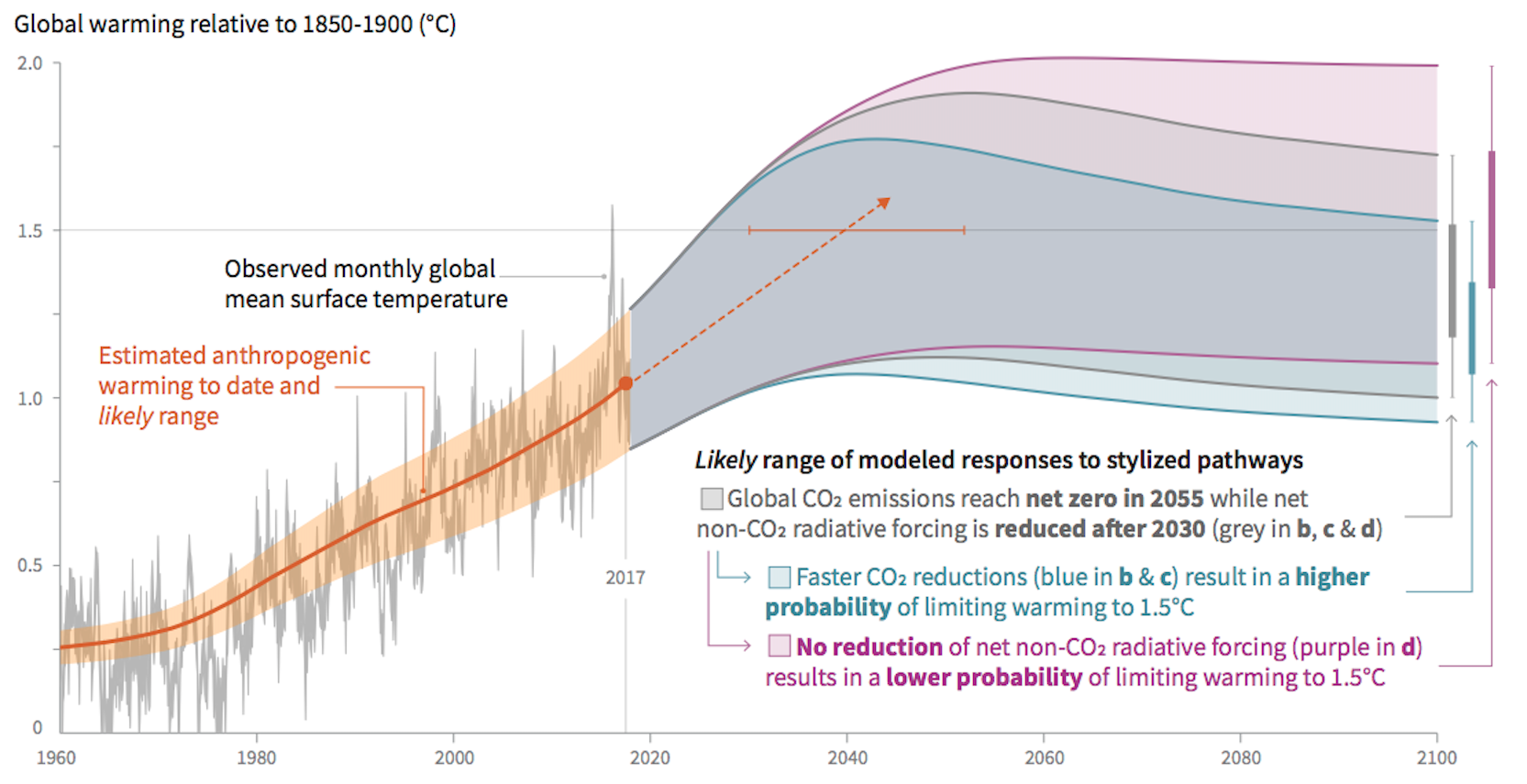
According to the Report, the actions required to limit global warming at 1.5°C are qualitatively very similar to those for 2°C, but more pronounced and faster over the coming decades. If we will keep on with the actual rate of emissions and warming, the 1.5 thresholds will be reached by around 2040, well before the end of the century. What we should do is to enhance all the actions that are able to move the change faster. All 1.5°C-compatible reduction pathways require a radical reduction in CO2 emissions, with net-zero CO2 emissions around the middle of the century.
Enlarge
http://ipcc.ch/report/sr15/
To meet the target would also mean to reduce energy demand, to achieve the decarbonisation of electricity and other fuels, to enhance electrification of energy end use, and to have deep reductions in agricultural emissions. In addition, we would not avoid those solutions that are able to remove carbon dioxide from the atmosphere while, in such a context, an even more relevant role is to be played by agriculture, forests, land use, sectors that are going to become a global net sink well before 2050.
The general message of the IPCC Report is quite clear: a half degree matters for the environmental, social and economic systems. We have a wide range of solutions, each of them, together with the others can help to reach the target, but we are still too slow and shy. Let’s speed up the transition.