




Click and read the full story
When the place you are settled in is not safe, comfortable, or profitable anymore, you might want to move. You might want to look for a new site in the world where you can find a better job, improve your lifestyle, raise your children in a healthier context, fulfil your dreams and aspirations.
Climate change is responsible for the transformation of the environment and society as we know them, and in many circumstances, it does so by making the environment less hospitable. For example, it shapes a world with higher temperatures or rarer natural resources, which in turn contributes to higher risks and conflicts. Migration can, therefore, be a possible response to growing uncertainties arising from these transformations, which can be hard – or impossible – to manage in situ.
Climate change impacts have proven to hit every societal sector, from agriculture to health, with deep economic implications. Strategies, technologies, and interventions to adapt to the changing climate and strengthen communities’ resilience do exist but are expensive. Consequently, developing countries tend to be not only the most exposed but also the most vulnerable to climate change, having fewer economic resources available to prepare and respond to climate-related shocks.
Migrating is expensive and the impossibility of moving far from a place that climate change hits or threatens can become a trap that leads to worsening inequalities and poverty.
We often come across descriptions of a dystopian future where waves of climate migrants are forcibly displaced by climate change, causing conflicts and competition over resources in the countries of destination. The truth is that future migratory flows are still uncertain, as are their consequences in hosting societies. What scientific research detects today is a complex landscape where migration is motivated by a combination of factors, among which the challenges induced by the changing climate. In this context, migration is already – and will keep being – a climate change adaptation strategy which for some is unaffordable, forcing them to stay put, unable to escape due to economic constraints. Migrating is expensive, and the impossibility to move far from a place that climate change hits or threatens can become a trap that leads to worsening inequalities and poverty.
However, opportunities linked to climate-induced migrations can emerge for individuals and societies if institutions are able to design appropriate policy responses.
Some cannot escape the effects of climate change

“The chance to migrate, as a consequence of a changing climate, should not be taken for granted, because migration, in particular international migration, is expensive”, observes Cristina Cattaneo, head of the Climate Migration Unit at the RFF-CMCC European Institute on Economics and the Environment (EIEE). “The warming trend and the decrease in precipitations experienced in many countries affects agricultural productivity, and this may motivate rural populations to move abroad or at least from rural to urban areas within the same country. However, data show that warming increases migration only from middle-income countries. In contrast, in poor countries, higher temperatures reduce the probability of migration: the combination of warming and low rural income imply less mobility, with the likely consequence being that rural populations go even deeper into poverty and subsistence modes.”
Domestic migration as a response to climate change
“Although cross-border migration attracts much attention and concern, there is still a lot of uncertainty concerning future migratory flows. Literature on the topic indicates that, in most cases, displacements due to current climatic events tend to be over short distances. High emigration costs make international migration harder for those who are most affected by climate change impacts. Internal migration is easier and more affordable for many economic and cultural reasons. For those who can move, the first choice is therefore to move from rural to urban areas. We may expect a similar pattern in future migrations, mainly characterized by internal movements”, explains Cattaneo.
Migration is not only an opportunity to adapt to the changing climate, but it can also turn into an “escape valve” for local tensions.
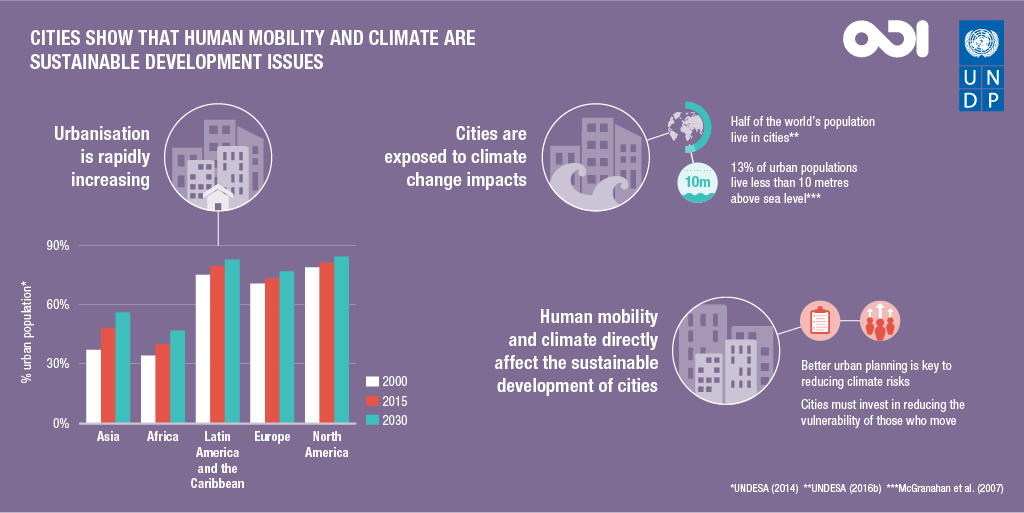
The risk is that cities will be unprepared to face rapid population growth due to higher rates of domestic migration. The lack of infrastructure, housing, health services, and education might push migrants into slum areas, thus stopping them from improving their conditions and finding the well-being they were looking for. “Internal climate migration implies a series of challenges that must be properly managed”, adds Cattaneo. “How migration policies are designed can transform this phenomenon either into an opportunity or into a serious issue. If well managed, migration can become an effective climate change adaptation strategy that stimulates urbanization and may speed a given country’s structural transformation, ultimately increasing migrants’ conditions and benefitting society as a whole. In contrast, the unmanaged growth of megacities will cause an impoverishment of the urban social fabric, with social, economic and security consequences.”
Both migration and not being able to migrate come with consequences
Migration is not only an opportunity to adapt to the changing climate, but it can also turn into an “escape valve” for local tensions. The phenomenon should not only be looked at through the lens of host countries but also through the lens of sending areas. Instead of focusing exclusively on the consequences of climate-induced migrations, we should also look at the consequences of not being able to migrate. Through this perspective, we might realize that when migrations are hindered, local conflicts linked to increased competition for limited resources due to climate change may increase. Furthermore, as climate change is one of the factors that can encourage or impede migrations, the trap it causes for poor people might have consequences that go far beyond the economy.
Conflicts in poor countries might be enhanced by climate change through the influence of hindered migration, unless policies do not act consistently
“In the recent study Should they stay or should they go? Climate migrants and local conflicts we investigated the connection between climate, migration and conflict, from the perspective of both receiving and sending countries. On the one hand, we analysed whether climate migrants have impacts on civil conflicts in destinations, where they might be a possible driver of social unrest, and on the other, whether migration mediates the negative effects of climate on conflicts in origin countries”, affirms Cattaneo. “We found no evidence that climate migrants increase the probability of conflict in receiving countries. At the same time, our study shows that emigration acts as an effective release valve that dissipates possible climate-induced tensions in origin countries. Consider that poor countries are also those where higher temperatures reduce the probability of international emigration, for the presence of poverty traps due to liquidity constraints in the rural areas, which are made more severe by climate change. From this follows that conflicts in poor countries might be enhanced by climate change through the influence of hindered migration unless policies do not act consistently.”
Migration policies are the key factor
Migration is multicausal. Individual and family motivations for migrating intersect with the socio-economic and environmental contexts that surround them, which include climate change impacts among the drivers. Some aspects – such as the presence of networks of prior migrants in the place of destination – may encourage and facilitate migration; others – such as economic constraints – can simply make migration impossible.
Migration is an adaptation response to climate change. But if other responses are available, they might be chosen instead of migration. The role of policy is to offer and facilitate these solutions whilst empowering mobility when moving is not a choice.
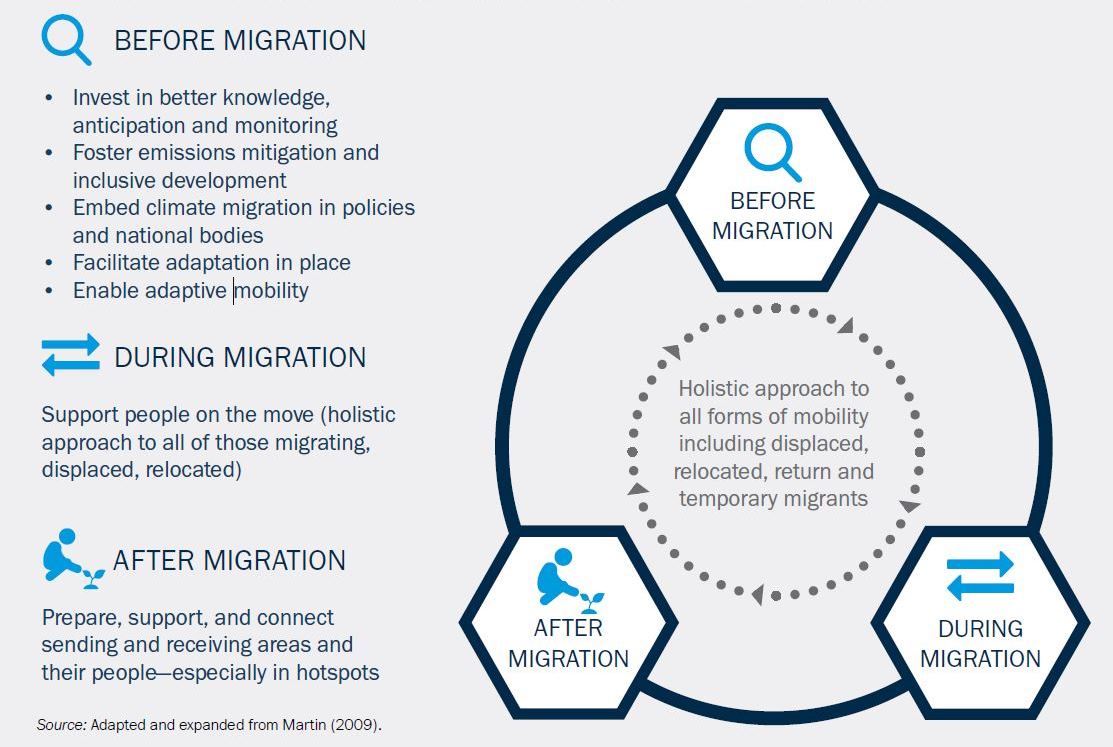
On the other hand, good migration policies play a critical role and must start by reshaping an international legal framework that still doesn’t recognize a legal status to those who are pushed to relocate by climate change. The recognition of the status of “climate migrants”, parallel to the existing “refugee” status, would indeed include internal migration and slow onset migrations, also safeguarding those who are not forced to move by a specific climate-induced disaster, but rather are forced to migrate due to complex and intertwined reasons.