





If on the one hand the scientific consensus is that reducing emissions can still slow climate change and therefore we must work towards this goal; on the other it is also time to start adapting to the inevitable changes that the future has in store. A strategic and managed climate retreat may be part of the solution. By conducting rigorous scientific investigations to establish what changes are becoming inevitable we can plan for them in advance and make sure that retreat is no longer a desperate process but rather an opportunity.
A new paper published in the Policy Forum of the journal Science (the peer reviewed academic journal of the American Association for the Advancement of Science), focuses on strategic and managed retreat in the face of some inevitable consequences of climate change: creating an approach to retreat that can help communities adapt and thrive, marking a shift from the status quo that often equates to ad hoc disaster relief measures. Adopting this approach turns the movement of people and development away from at risk areas into an opportunity rather than a defeat. “The challenge is to prepare for long-term retreat by limiting development in at-risk areas,” and therefore planning for further action based on responding to specific triggers and constantly monitoring and evaluating conditions.
Ad hoc retreat strategies, that “focus overwhelmingly on physical removal of people and buildings, with limited discussion of the social, cultural, psychological, or longterm economic consequences”, are not cost effective and create traumatic migrations that often relocate people from one at risk area to another due to bad planning and disaster induced haste. In contrast, an approach that prioritises the reconceptualisation of retreat so that equitable and efficient plans can be put in place can change these dynamics. In particular, with regards to poorer members of society, whereby adequate planning can help those that are most vulnerable to change.
In fact, a key part of the concept outlined in the policy paper is equitable retreat. Cristina Cattaneo, scientist at EIEE who is responsible for research on climate induced migration, claims that: “the risk is that because of climate change people become poorer and then those that are really poor remain trapped in problematic areas […] strategic climate retreat can help prevent this.”
Miyuki Hino, co-uthor of the paper also suggests that: “No matter the circumstances, moving is hard […] People have chosen where to live for a reason, and it is often difficult to find a place to move to that meets all their social, cultural and financial requirements […] One major challenge with retreat is that we’re so focused on getting people out of harm’s way, we miss the chance to help them move to opportunity.”
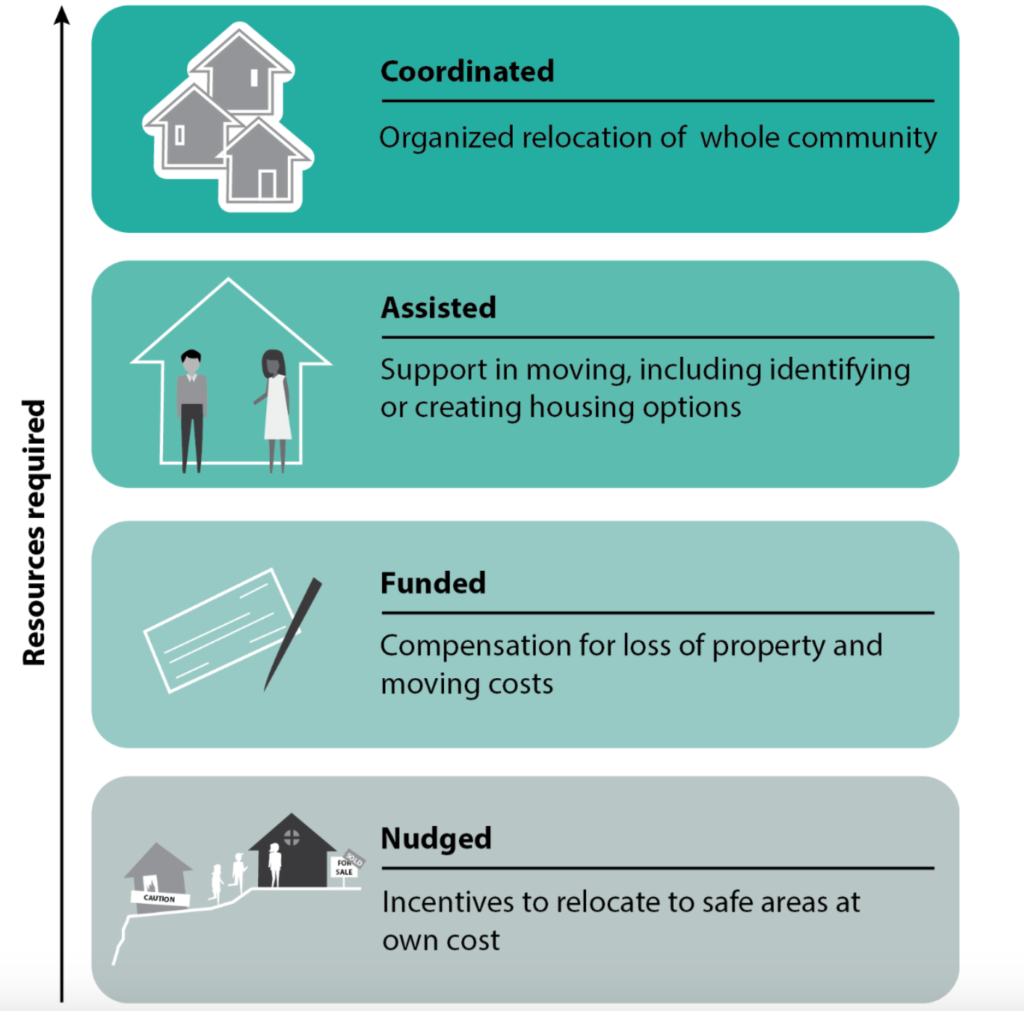
A preferred alternative is for retreat to be integrated into the pursuit of broader societal goals (the strategy) and its implementation tailored to context-specific goals (the management). This reorientation is needed to innovate, deploy, and refine socially viable and equitable approaches to retreat.
Taken from: The Strategic and Managed Retreat policy paper
There is a general scientific consensus that climate change will lead to increasing instances of forced retreat from at risk areas, whether driven directly by disasters, market forces, or government intervention. For this reason, an approach to adaptation that relies on strategic and managed planning for climate retreat could provide invaluable opportunities. Whilst renouncing fatalistic doomsday scenarios, and the inevitable passivity that they cause in the fight against climate change, it is also crucial that at risk communities are adequately prepared and that development plans consider climate related risks.
At the same time implementing such a far reaching and complicated strategy that encompasses so many areas is fraught with complications. A view shared by Cristina Cattaneo, expert in climate migrations: “When such positive strategies are so complex then it is difficult to implement them.” Cattaneo sees this as a major drawback whereby by trying to do everything you risk being able to do little. However, she also explains that if these principles are implemented in targeted strategies, for example by influencing urban development plans, they have the potential to create significant contributions.
“At times there is a lack of strategy and overall vision and the paper provides a solution by advocating an approach that in the short run stops building in at risk areas and in the long run moves those that are already in at risk areas […] If this can help change the approach and insert climate variables in urban planning then it is a positive contribution.”
Cristina Cattaneo, scientist at EIEE
An excellent example is that of Indonesia. The South-East Asian country is working towards relocating its administrative capital due to issues of severe subsidence, which makes the coastal city extremely vulnerable to rising sea levels. An excellent example of strategic and managed climate retreat.
Until now retreat has been tackled as “a last resort, a failure to adapt, or a one-time emergency action; thus, little research has focused on retreat, leaving practitioners with little guidance.” On the other hand, if retreat can be reconceptualized and implemented in a way that promotes long-term development goals, identifying why, when and where it should occur then it can provide an opportunity for at risk communities both in affirming their cultural identities and their economic development.
With the IPCC predicting that global-average sea level rise could vary between 0.11 to 0.77 m in the next century (although this could rise to up to 6 metres when considering the instabilities associated with the Antarctic Ice Sheet) and environmental migrants set to increase over the next couple of decades, strategic and managed climate retreat has to become an area of focus in policymaking. This will involve not only limiting development in at-risk areas but also developing safer areas in a way that “incorporates socioeconomic development and management that is innovative, evidence-based, and context-specific.”
However, a strategic and managed climate retreat cannot be about resigning to the inevitability of climate change and catastrophe. Rather, it must become a way of implementing an efficient and equitable adaptation strategy to cope with urgent and growing climate risks.